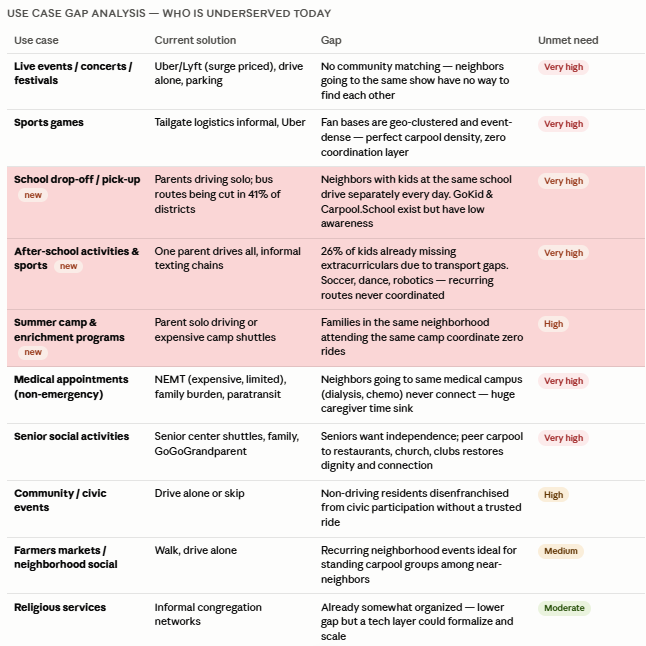
Absolutely! Low cost carpooling solutions (a ‘carpooling watch’ similar to Neighborhood Watch) would help with other needs such as defraying the exorbitant costs of transportation, the social isolation epidemic, and the reduction of public transit resources. Claude identified obvious and less obvious use cases below.
Claude:
“The data paints a compelling and multi-layered picture. Yes — the need is very real, and it goes well beyond commuting.The data makes a strong case. Here’s the synthesis:
Events are the biggest untapped opportunity. Fetii’s use cases already include concerts, sports games, and festivals — and they’ve built a $12M+ business on it. But Fetii is a for-hire van service; EventCarpooling would be the peer-to-peer layer where neighbors with cars find each other before they ever need Fetii. Those two things are complementary, not competitive.
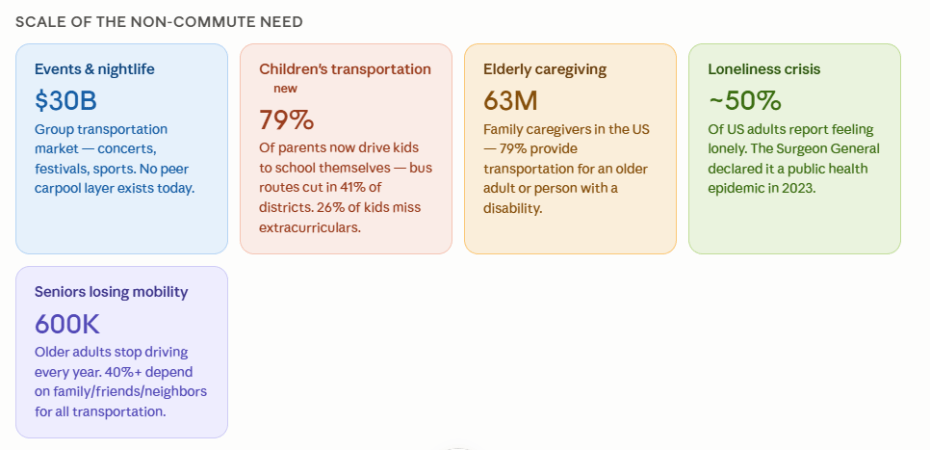
The caregiving gap is enormous and underappreciated. 79% of the 63 million US family caregivers drive seniors. Separately, 79% of parents are now the primary school transport for their kids. These are different families — often the same parents doing both. Neighbors already going to the same school, clinic, or senior center could share that burden. They just have no way to find each other. The digest model solves exactly this.
The loneliness angle is bigger than transportation. Approximately half of US adults experience loneliness, and the Surgeon General declared it a public health crisis. Scholar Robert Putnam documented that every ten minutes of additional solo commuting time correlates with a 10% drop in social connectedness — and the reverse is also true. A shared ride to a local event is a conversation, a relationship, a neighbor who now has your number. EventCarpooling isn’t just a logistics product — it’s a social infrastructure product, which gives it a much stronger community mission and grant/sponsorship angle.
The white space: Corporate commute carpooling is crowded. Scoop Commute has nearly 10 million trips, with the biggest volume in California and Washington. But nobody — not Scoop, not Waze (which shut down its carpool app in 2022), not Uber — has built a trusted, community-rooted, event-first carpool layer for the other 16 hours of the day. That’s the opening.”