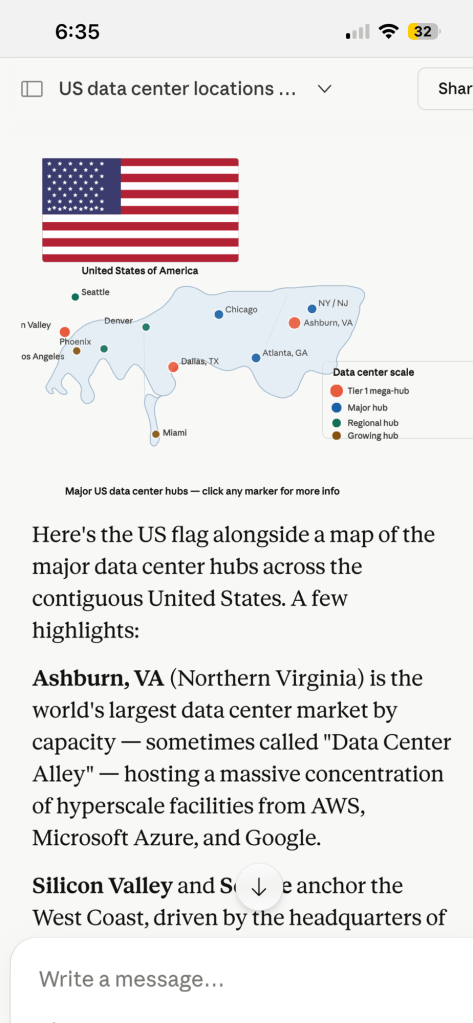

I asked the AI products themselves. US-based data centers power a majority of users based in the US.
☑️ Gemini
☑️ ChatGPT
☑️ Claude
✅ DeepSeek
This definitely protects US patents and American innovation. Jobs and economic growth help in some regions.
The seemingly inverse of this question is what would be good for the environment, affordability, and quality of life? Would using a 100% offshore AI product based on open source (e.g., DeepSeek) lower my carbon footprint, while reducing consumer energy and water bills?
America once made everything from TVs to refrigerators to gym equipment. Businesses decided manufacturing wasn’t worth the cost and sent much of it offshore. The information and IT economy is also going offshore. However, the AI economy needs guardrails and sending all data centers to low cost GEOS poses massive risks.
Similar risks were considered in the 80s to the 2000s, and still, there was a massive export of business manufacturing and jobs. At some point, it won’t make sense to make America the world’s data center hub. That litmus test is already happening in towns across America. Most of the American economy is currently being propped up by AI investments. What happens when the ROI gets diminished? What happens as better, cheaper, and lower carbon footprint AI products arrive from overseas?
Research is below on America’s data centers.
Answers:
1. Google Gemini:
“Within the global network, the United States holds the highest concentration of infrastructure dedicated to Gemini, and specifically, the Midwest has emerged as the “AI Engine Room” of the country.
While Northern Virginia has historically been the “Data Center Capital of the World” for general internet traffic, Google has shifted its massive AI-specific investments—especially those housing the TPU (Tensor Processing Unit) clusters that power Gemini—into the central U.S.
The “Big Three” AI Concentrations
The highest density of Gemini-associated hardware is currently found in these three specific hubs:
Council Bluffs, Iowa (The Central Hub): This is widely considered Google’s largest and most advanced AI site. It is often the first to receive new generations of hardware (like the TPU 8t/8i). Because of its massive scale and access to renewable energy, a significant percentage of Gemini’s global “reasoning” happens here.
Pryor, Oklahoma (The ML Powerhouse): In 2024 and 2025, Google poured over $9 billion into its Oklahoma campus specifically for “AI-ready” infrastructure.
2. ChatGPT:
“The biggest clusters (often called “data center hubs”) are:
- Northern Virginia (Ashburn area)
The largest in the world (“Data Center Alley”), with massive presence from AWS, Microsoft, Google, etc. - Silicon Valley (California)
Historically important, still dense but constrained by power/land costs. - Dublin
Major European hub due to tax structure and connectivity. - Singapore
Key Southeast Asia hub (though expansion is constrained). - Frankfurt
Europe’s internet exchange backbone location. - London
Large but geographically distributed. - Tokyo
Major Asia-Pacific hub. - **Northern California & Oregon
Big hyperscale cloud regions (especially for Amazon Web Services, Google Cloud, Microsoft Azure)
👉 The single largest concentration globally is Northern Virginia.
Most US user traffic is handled within US regions (e.g., Virginia, Oregon, Texas)However, it can be processed outside the US if:
- systems are balancing load
- a specific model or service is hosted elsewhere
- failover or redundancy kicks in”
3. Claude:
“Current Infrastructure
Anthropic runs on a mix of cloud providers rather than a single proprietary network. Anthropic uses multiple cloud service providers to process customer data, as documented in their Subprocessor list at trust.anthropic.com. Claude
Geographic Routing
By default, Anthropic may route customer traffic to select countries in the US, Europe, Asia, and Australia. Data is stored in the US. So no — your US-based searches are not guaranteed to stay on US-based infrastructure by default, though in practice US traffic likely hits US nodes most of the time. Claude
New US Data Centers Coming
Anthropic recently announced a $50 billion investment in American computing infrastructure, building data centers with Fluidstack in Texas and New York, with more sites to come. These facilities are described as custom-built for Anthropic, and sites are expected to come online throughout 2026. Anthropic
What Anthropic Doesn’t Disclose
Anthropic doesn’t publicly name specific data center cluster identifiers, rack configurations, or precise facility locations — this is standard practice for security and competitive reasons.”
4. DeepSeek:
“Based on the available information, the data center clusters powering DeepSeek are primarily located within China. The company’s primary self-built facility is in Inner Mongolia, but its infrastructure also extends to other regions through various partnerships.”
- For its direct service and core training, DeepSeek relies on a network of data centers and computing facilities located across China.
- For users and developers, the open-source nature of its models makes it possible to run DeepSeek on computing infrastructure anywhere in the world that has the necessary hardware.